Featured News

Showing posts with label Andalucia. Show all posts

Goodbye Blogger: See theflexiblechef.co.uk

Thank you Blogger for being the platform bringing me from random Facebook postings to blogging. Sometimes it seems like full time unpaid work but on the whole I have enjoyed it.

However, the time has come for me to say goodbye as I migrate my postings from here to WordPress. Given that I spend so much time blogging I have started to feel like a professional and dare I say that WP is just that.

Anyway, thank you to the people and developers behind Blogger.

My blog can now be viewed at my website http://www.theflexible.co.uk - it is a work in progress.


Learn more »

Mr Bean: Andalucian style

Baked beans, also known as Boston beans or Navy beans. The commercial product is packed with sugar and salt – even the reduced versions. However, it is relatively easy to make H J Heinz rather jealous by making them in your own home.

It takes a while (simmering tomatoes and the ingredients for 2-3 hours) but you can save time by buying canned or jarred haricot beans. In Spain all beans tend to be lumped into the ‘Alubia’ category but the small ones on the supermarket shelves are haricot and the large ones are generally butter beans.

This recipe gives a delicious tangy, zingy flavour that you will never, ever, ever get out of a tin no matter what the marketing people at Heinz say.

For the sauce:
1.5kg ripe and juicy tomatoes of your choice, chopped
75ml cider vinegar
5 cloves
2 green cardamon pods
¼ tsp white pepper
¼ tsp ground nutmeg
¼ tsp ground cassia bark (you can also use cinnamon)
1 tsp Paprika (I use hot smoked)
50g sugar
2 cloves garlic, chopped
2 or 3 sun dried tomatoes (rehydrated), chopped

This is the easy bit. Add all ingredients into a large pan, bring to a boil then simmer for 2 ½ or 3 hours.

Allow to cool before passing through a food mill, add the beans to the liquid then spoon into sterilised jars.


They are so gorgeously delicious they won’t last very long. Enjoy on hot buttered toast.


Learn more »

Pickled as a Newt

The term pickle is derived from the Dutch word pekel, meaning brine. Pickled as a newt is an English phrase for being pissed.
Pickling is the process of preserving food in brine or vinegar and this method has been used for thousands of years, particularly in India and other parts of Asia.
In Fiji, for example, before a man could woo a girl he had to show his prowess by allowing her parents to inspect his pickling pits in order to prove he was good marrying material. I am going to try something similar - you show me yours and I'll show you mine.
Even Christopher Columbus's ships carried pickles as they are packed with vitamin C and thus helped avoid scurvy. Brits are often referred to as ‘limeys’ because their ships carried citrus fruits for the same reason.
In days gone by fruits and vegetables were pickled in order to survive hard and long winters. Now, in the main, we can pickle in times of plenty to enjoy in the winter. Pickling has enjoyed a recent boon from chefs and foodies alike (and me) as they add an interesting and acidic punch to dishes and it is very cheap to produce.
However, apart from pickled herrings, pickling is rather new to me. And now I have the pickling bug from onions, mixed vegetables to chillies. 
Pickling vegetables not only improves their texture and flavour but it can also make them more nutritious - by introducing B vitamins produced by bacteria.
And recently I watched The Hairy Bikers' Asian Adventure – Korean episode on catch up and there was Kimchi, I had it once in Hong Kong and now I am going to pickle cabbage, Kimchi Andalucían style. 
According to Korean scientists, Kimchi contains as much as twice the levels of vitamins B1, B2, B12, and niacin as unfermented cabbage contains. Now you know.

Meanwhile, whilst in pickling mode and having some green chillies to hand (Francisco, in my local fruit and veg shop told me they were muy, muy picante, he even wagged his finger to emphasis the fact) I decided to give it a go and here’s the recipe which has been specially requested by a friend, Fran Rajewski, who is slowly recovering from surgery. I’m sure my picante pickled green chillies will help with her mending. 

Use your usual sterilisation method. I place my jars in the oven for 10 minutes at 120°C and the lids under boiling water for the same time.

Place the chillies in a colander and scold with boiling water, set aside to cool as you will have to pierce them in order that the pickling solution penetrates them. 

Place them into the jar and add whatever spices suit you. I added:

Mustard seeds
Peeled garlic
Black pepper corns
Bay leaves
Cassia bark
Coriander seeds

Plus a teaspoon of salt and a good sprinkle of brown sugar.

Apart from flavouring the vinegar the spices are antimicrobial – they kill micro-organisms or at least they inhibit their growth.

Now cover with vinegar of your choice (white wine in my case) making sure everything is submerged. Now tap the jar in order to release any air bubbles, screw the lid tight then store in a cool dark place until the chillies start to turn light green. 


Learn more »

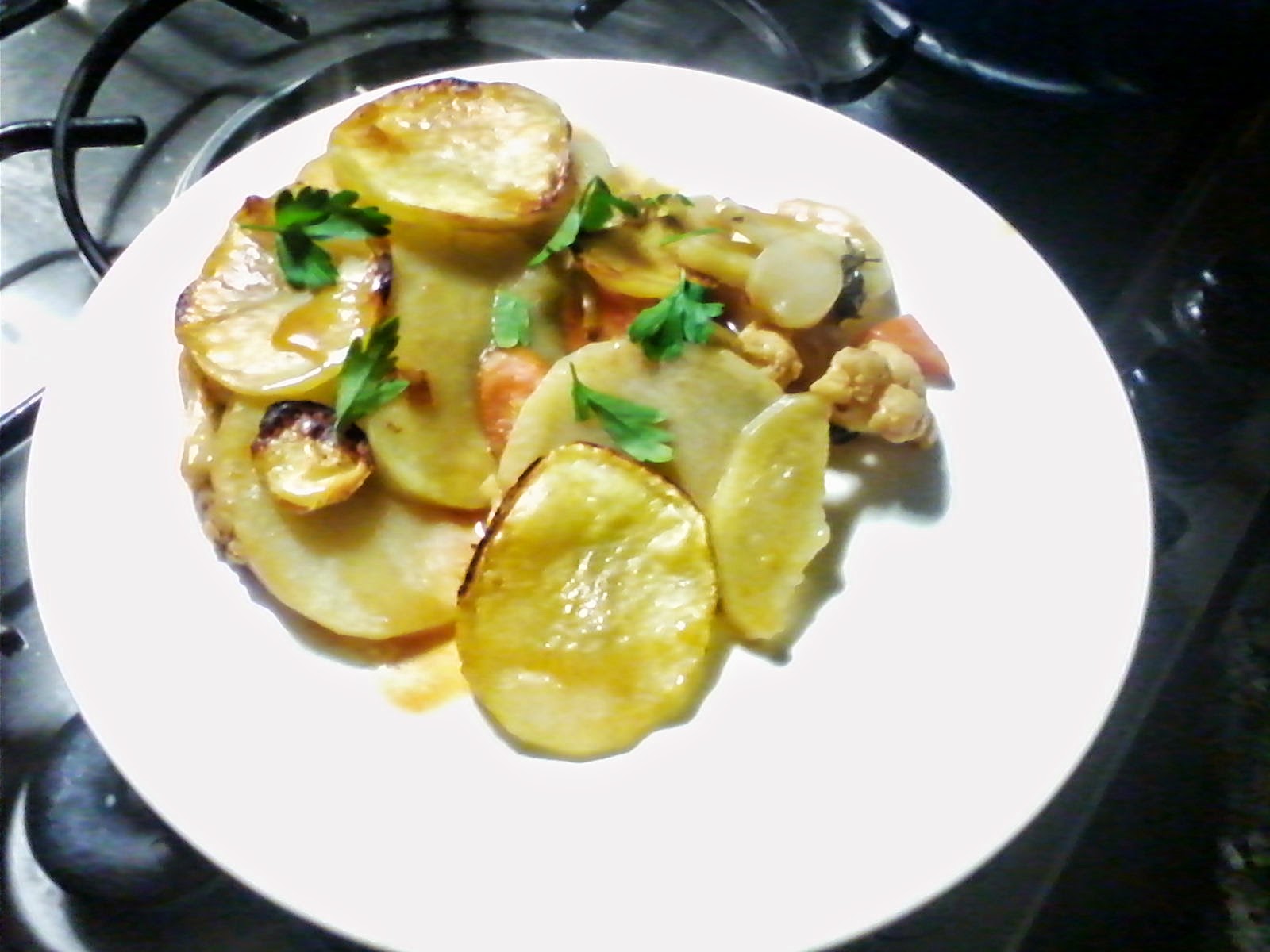
Porc à la Normandie - Cerdo Normandía

I haven’t had much by way of meat lately but a pork chop loitering in my freezer grabbed my attention.

And whilst it was defrosting my subconscious was working overtime to come up with a recipe to do justice to my sage plant and a bottle of French cider acquired recently during a reconnoitre to Granada.

I used to live in France so I know this is my made up version but at least the cider is from Normandy. The pork is Andalucian and the shallots are from France. The sage is from my Andaluz patio.

Using a suitable casserole dish this is cooking for one…

Brown a pork chop in a little oil
Sauté shallots, sliced carrot and a few cauliflower florets
Add a garlic clove
Add a splodge tomato purée
Add bay leaf, ground black pepper
Add peeled and sliced apple
Add a couple of slugs of cider
Then a ladle of hot stock to cover the ingredients
Sprinkle with dried or fresh sage
Layer with thinly sliced potatoes and a few dots of butter

Place in a preheated oven at 190°C for 35 minutes or until the top layer of potatoes have started to brown and crisp up. 


Learn more »

India: It's a Ganga!

The start of our trip was an hour or so drive to Cordoba to connect with the high speed AVE train to Madrid which whisked us there in under 2 hours in absolute comfort and even though we did travel by tourist class there was plenty of leg room - please note Virgin Rail & Ryanair.

Staying overnight near Madrid airport we came across Rest. Hmos. Romero nestling away on an industrial estate but within easy walking distance of our hotel.

6 beers with tapas
Menu del dia (3 courses)
2 glasses red wine
2 coffees

Total 23€

Ganga is Spanish for bargain.


Learn more »

Multicultural gathering

Curry. What better way to bring people together. 

In rural Spain it is not easy to pop out for what in the UK is the most common takeaway, curry. 

So a few days before setting off to India I held a curry night at Casa Adora attracting nationalities from UK, France, Belgium and Spain. Oh and Diabetic Tony from the Midlands. 

They all agreed it was picante! 

For the curry lovers here was the menu: 


Learn more »

CAN YOU STAY OFF THE BOOZE FOR 31 DAYS?

Whatever your circumstances are there is always somebody worse off than you, no matter how bad you feel and in this respect it is in my nature to endeavour to raise money for worthy causes.

Until recently I was living in England’s Lake District which gave me the opportunity to raise funds by yomping* across Morecambe Bay (whilst the tide is out, of course).

The Big Stride, Wellies Required, etc., all yomps raised money for Everyman – stamp out male cancer… which are the ones men generally ignore, prostate and testicular cancer.

Anyway, whilst enjoying life in rural Andalucía I have decided to do something that even I think is a real challenge = Dry January 2014.

Can I stay off the booze for 31 days? I think I can but wait a bit… what about my existing charity effort of meeting up with diabetic Tony every Sunday for his weekly tipple… and then there’s Burn’s Night on the 25th…  oh dear, I have fallen off the wagon already.

And if by chance you would like to support this effort by donating to Everyman and Alcohol Concern then you can do so at my fund raising page: 


*yomp

BRITISH. informal
Verb: gerund or present participle: yomping
1.(of a soldier) march with heavy equipment over difficult terrain.


Learn more »

Who mentioned sausages?

And I don’t mean Androlla, Botifarra, Botillo, Chorizo, Embutido, Fuet, Longaniza, Morcón, Sobrassada or any other variety of Spanish sausage.

I was chatting with my friend Paulina in England last week. She told me that it was raining, cold and her central heating was on and that she had a scarf around her neck, I don’t know if she was implying that she was trying to hang herself but if she was then I managed to talk her out of it.

For comfort she was cooking sausage and mash. Cannot blame her really can you? But the mention of sausages must have subliminally immersed itself into my subconscious because on Saturday I found pork sausages in the butchers in Baena. I bought 6 fat bangers.

I wonder if Paulina realised that during her frozenness she actually inspired me to cook sausage, mash, caramelised onions, with an outside temperature of over 30°C that I enjoyed with a glass of wine and a view from the roof terrace, what more could one want? 

Thanks Paulina.

And with it do you prefer onion gravy, brown sauce or something else? Well, my onions were finished off with Madeira wine. Paulicious. 


Potato ricer


Learn more »

Mauritian Goat Curry

Goat meat is not easy to source in rural Andalucía unlike Brixton or places in the Midlands, and notwithstanding the number of goat herds I have seen, it was still very surprising when I stumbled across it at Carrefour - I grabbed a leg, like you do. Cabrito, a word of Spanish origin, refers specifically to young, milk-fed goat and that's what I purchased.

According to Wiki: As of 2010 goat is the most widely consumed red meat, eaten by more than 70% of the world's population. It is a staple of Africa, Asia and South/Central America, and a delicacy in a few European cuisines.

Despite being classified as red meat, goat is leaner and contains less cholesterol and fat than both lamb and beef, and fewer calories than beef or chicken; therefore, it requires low-heat, slow cooking to preserve tenderness and moisture.

I followed one of Gordon Ramsay's recipes, more or less anyway - Mauritian Goat Curry, delicious it was too.

Make a chilli paste by whizzing up a small red onion, 2 garlic cloves, 2 chillies (seeded if desired), a knob of fresh ginger, seasoning and oil ... 

Cut the meat into bite size pieces and brown in a little oil, setting aside.

Fry off the chilli paste, then add turmeric, cumin seeds, mustard seeds, cinnamon stick, a star anise (use fennel seeds if you wish) cardamom pods, brown sugar, few curry leaves, chopped fresh tomatoes, stock...

Add meat back to pan, you can add some cubed potatoes at this stage too, bring to a boil then turn down to a simmer. Open a bottle of wine then return in 3 hours or more... you may want to open another bottle - the meat should be tender and the curry will have thickened up.

Serve sprinkled with fresh coriander leaves, Indian apple pickle and naan bread on the side.


Learn more »

Vegetable bake with Parmesan, Pine Nut & Herb crust

Just what you need on a baking hot Andalucían day I hear you say. But if you wait until the late evening (9.30pm in my case) and leave your bake to rest until it reaches room temperature (which is still quite warm) it is absolutely delicious.

This is a great way to use up vegetables and mine consisted of:

Aubergine
Leek
Carrot
Tomatoes
Red pepper
Green beans
Brown rice
Red chilli
Garlic
Black pepper
Turmeric powder
2 cubes red pepper coulis (see previous post)

And for the crust:
Breadcrumbs
Garlic
Poppy seeds
Toasted pine nuts
Parmesan
Fresh herbs (parsley, basil & thyme)
White pepper

Boil the rice then fry off the vegetables in batches (except the tomatoes). Whiz the crust ingredients together.

When done add the rice to the vegetables and mix together so that the rice takes on the yellow pigment of the turmeric .

Place the vegetable mix in an oven proof dish, slice the tomato over then sprinkle with the crust mixture, drizzle over a little olive oil. Bake in a pre-heated oven at 180°C for 20 minutes or until golden.


This goes very well with a glass of something chilled whilst sitting on a roof terrace taking in the view of the olive groves as the sun goes down. 


And by 10pm

Learn more »

Could you watch your food being killed?

Rabitena is a 60 year old man who rears lambs in Alcaudete. His father, who was born in La Rabita, hence his name, did the same and his father's father and the one before that... so when Rabitena dispatches one of his lambs he defies diktaks from Brussels or anybody else to stop what has gone on for generations before. And who I am to complain as I chose one, watched it peacefully dispatched, skinned, gutted and cleaned. It was done with love as I swilled an obligatory bottle of Cruzcampo (chilled it was too).  

I know I am top of the food chain so I don’t have any hang-ups about what I eat but I do know that I have more of a conscience than most supermarket shoppers.

Knowing that my food is reared to the best of the ability of the farmer, has traceability and above all that no matter how young or old the animal is or was, it has been treated well and with respect and enjoyed a half decent diet, freedom and fresh air (just like we do) before being dispatched to the great farmyard in heaven where my Dad now lives.


I am not extreme about it and you’ll never find me on a protest march either but I am concerned about this and how much pollution drops out of the sky from the zillions of flights across our skies every day. I think about it but it doesn't stop me from flying.

So I eat most things including chicken’s feet but I draw the line at sheep’s eyes. 


Learn more »

A walk in the park

Or in my case a caminar en el campo. Within seconds of my front door is a track that skirts around my village through the olive groves. I walk this a route often, enjoying the tranquillity, wild flowers, rabbits, hares, birds and an occasional butterfly. I didn't see a single soul in the groves. I like that.

Wild Chicory
Chicória (Chicory)

The last of the poppies


I am in the heart of Andalucia’s olive growing region and no matter in which direction you turn you can see nothing but a green sea of olive groves.  If you don’t like olives then you’ll probably not enjoy this walk very much but I love it.  


Reserved for hunting


Caperones

The route takes a bit less than one hour which includes a visit to Frutas Mati for some fresh vegetables on the way back. Later I am going to cook something with the fresh and vibrant red and yellow peppers that winked at me in Fransisco’s shop.


Learn more »

Chirla Huelva

When the weather is good there’s nothing better than a light seafood pasta and as I was able to pick up baby clams I decided that me and roof terrace plus my chilled Galician wine with a little bit of Sweetback on my iPod deserved Linguinie Vongole.  It is easy to knock together and this is my favourite version. This serves one hungry person. And I am hungry.


Ingredients:
Clams – I ordered dos puñados but being a girl the server informed me that she had small hands so I settled on three handfuls.
100g dried linguinie (or spaghetti)
Extra virgin olive oil
A fat clove of garlic, finely chopped
Red chill, as much or little as you wish, finely sliced
A small knob of fresh ginger, finely chopped
A little tomato purée
Splash dry white wine
Handful flat leaf parsley, roughly chopped
Lemon – small amount zested, a large squeeze of juice and a quarter for decoration

Method:
Rinse and clean the clams
Cook pasta as per instructions on the packet, less 2 minutes
Soften the garlic, ginger and chilli in the oil in a pan then add the tomato purée
Drain the clams and add to the pan together with the wine – turn up the heat. Shake and cover and cook until most have opened. Discard any unopened ones
Drain and add the pasta, toss well and leave for one minute,
then stir through the chopped parsley, lemon zest and juice, season to taste and serve immediately

My clams were from Andalucía’s Gulf of Cadiz coast. Cheap and very, very delicious. 
Learn more »

When it is your birthday in December it's best to celebrate it in Spain


My son and my future daughter-in-law visited me in December 2012 as part of his 30th birthday celebrations in Spain. They were only with me for a few days but we crammed a lot in. And when we weren't walking then we were eating and drinking. Feliz 30 cumpleaños, Chris.


Laguna Salobral viewed from the Via Verde


OK, so this was at the coast. It was cold and a long way from the Via Verde


Learn more »

The Via Verde Aceite de Jaén – Part I

The Vía Verde de Jaén is the old railway line which used to transport olive oil from Jaén to the coast, originally built between 1882 and 1893 which closed in 1985. It is close to where I live. The path is now asphalted or covered in packed grit covering 55km between Jaén and the Guadajoz river, a natural border between the provinces of Jaén and Córdoba where it joins the Vía Verde of the Subbética. 

The route starts in Jaén and passes by the towns of Torredelcampo – Torredonjimeno – Martos and Alcaudete.

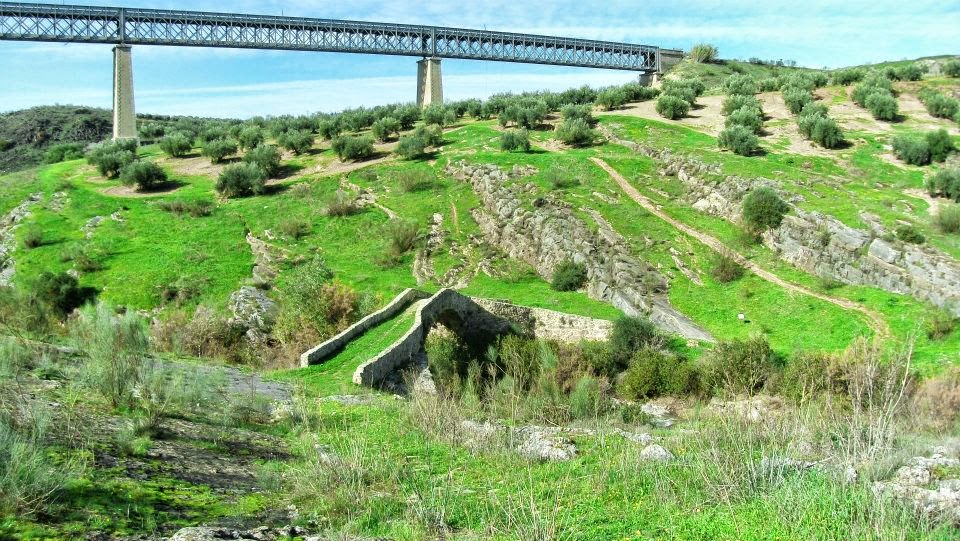
One day in November 2012 I joined friends, Steve and Steffi with my neighbour’s son Ruben to search for the Roman Bridge on the via verde. We set off from Alcaudete old train station heading north towards Martos. It was good for us three English people to have Ruben as our guide as he spoke a little English and could explain the names of the trees and plants to us.

The weather was great, the views were spectacular and we found the bridge after several kms. And after the walk there was time for a couple of beers and tapas.


And Eddi Fiegel, of The Guardian wrote: Joggers in wraparound shades chugged past the bricked-up, graffiti-covered, 19th-century Martos station, and on the start of the path we encountered a few posses of cyclists and the odd dog-walker – but these were the last signs of human life  we'd see for the next five hours. 

And that's exactly how it is but on this day we walked in the opposite direction. 


Learn more »