Featured News

Showing posts with label Fruit & Veg. Show all posts

Cooking Sous-vide on the Cheap

Sous-vide is a method of slow cooking food (in sealed plastic bags) in a water bath. It's a French invention wouldn't you know? 

To buy a half decent Sous-vide gadget will set you back over 200€ but my method is much cheaper and you don't have to buy anything except food grade cling film (one that’s marked suitable for microwave).

The big advantage of using this cooking method is that the meat retains its juiciness whilst taking on the seasoning and herbs that you coated it with.  The end result is moist meat.

As an example, take a skinless chicken breast, season and/or coat in herbs or spices of your choice then tightly roll up in cling film making sure the ends are secure and water tight.  Boil up a large pan of water and then turn down to a gentle simmer (should be making a slow plop, plop sound). Now place your sausage looking wrapped chicken breast into the water and leave it alone for around 30 minutes (depends on the size of your ‘sausage’ of course).


When it has reached doneness remove carefully and place on a chopping board allowing it to rest for a few minutes otherwise you’ll burn your fingers when unwrapping the breast as any liquid escaping will be rather hot. 

I served mine with cauliflower and potato gratin and green peppercorn sauce.


Learn more »

Risotto: It is all in the stock

Risotto is simple yet comforting, you just need a good home made stock and not a stock cube or powder.

Make your own and freeze what you don’t need for another day.

Chicken carcass, bones and wings
Carrot x2
Celery stick x2
Onion x1
Bay leaf x3
Black pepper corns 6
Tomato x1
Leek x1
Fresh parsley and thyme (big handfuls)
3 ltr water

Roughly chop the vegetables and place in a large pan with the chicken, water and remaining ingredients. Gently bring up to boiling point then reduce to a gentle simmer .

Simmer for 3 hours skimming off any scum.

Strain through a fine sieve squeezing every last drop of liquid and loveliness from the soft vegetables.


For an ‘oriental’ stock add garlic and a couple of chilles (with or without seeds). 


Learn more »

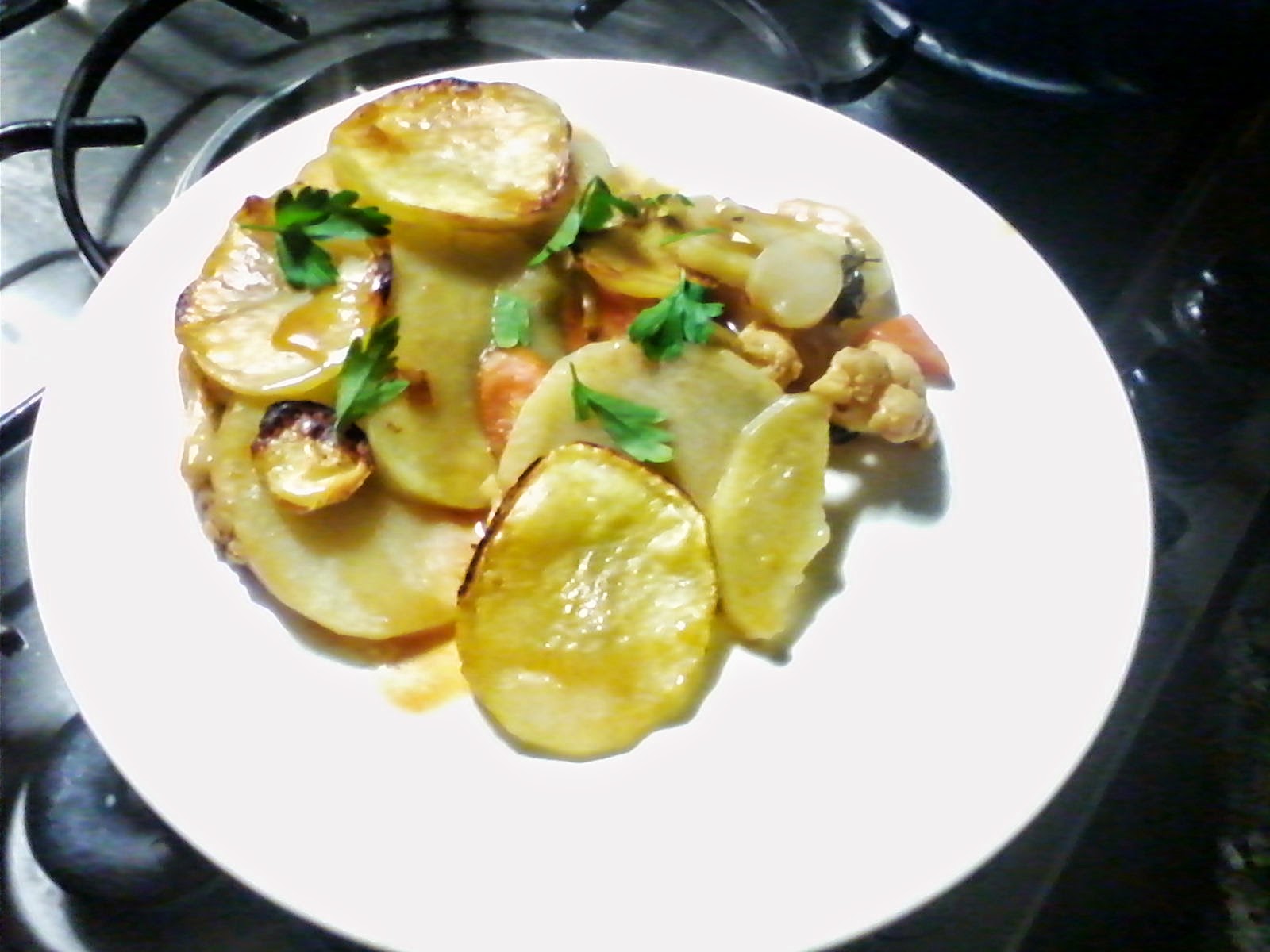
Porc à la Normandie - Cerdo Normandía

I haven’t had much by way of meat lately but a pork chop loitering in my freezer grabbed my attention.

And whilst it was defrosting my subconscious was working overtime to come up with a recipe to do justice to my sage plant and a bottle of French cider acquired recently during a reconnoitre to Granada.

I used to live in France so I know this is my made up version but at least the cider is from Normandy. The pork is Andalucian and the shallots are from France. The sage is from my Andaluz patio.

Using a suitable casserole dish this is cooking for one…

Brown a pork chop in a little oil
Sauté shallots, sliced carrot and a few cauliflower florets
Add a garlic clove
Add a splodge tomato purée
Add bay leaf, ground black pepper
Add peeled and sliced apple
Add a couple of slugs of cider
Then a ladle of hot stock to cover the ingredients
Sprinkle with dried or fresh sage
Layer with thinly sliced potatoes and a few dots of butter

Place in a preheated oven at 190°C for 35 minutes or until the top layer of potatoes have started to brown and crisp up. 


Learn more »

Multicultural gathering

Curry. What better way to bring people together. 

In rural Spain it is not easy to pop out for what in the UK is the most common takeaway, curry. 

So a few days before setting off to India I held a curry night at Casa Adora attracting nationalities from UK, France, Belgium and Spain. Oh and Diabetic Tony from the Midlands. 

They all agreed it was picante! 

For the curry lovers here was the menu: 


Learn more »

Cutting onions makes me cry (sometimes)…

Peeling, cutting, chopping, slicing raw onion releases an enzyme and amino acid which creates an irritant that burns and makes your eyes water.

If this is a problem for you then try peeling an onion under running water, chilling them in your refrigerator, use a sharp knife (cutting rather than crushing), wearing goggles helps but then again so does a gas mask.

An onion a day keeps the doctor away:

Onions contain phenolics and flavonoids that have potential anti-inflammatory, anti-cholesterol, anti-cancer and antioxidant properties.

The skins of onions contain powerful and natural anti-histamine which has shown to help hay fever sufferers.

Onions also contain Quercetin which is recognised as a potent antioxidant and onions don't have to be eaten raw to maximise their health benefits as they retains all of their powerful goodliness even after cooking.

So there, it is good to know your onions.

And lastly, if you are desperate to get rid of the smell of paint from a newly decorated room simply place a halved onion in the room.


Learn more »

Aubergine Pizza:One for the kids

I got this idea from a link with Julia Child who brought French (and Mediterranean) cooking to Americans. She was born in 1912 and after WW2 studied and worked in France and became the USA’s Elizabeth David or Mrs Beeton.

I have several of Elizabeth David’s books and she really made Britain aware of olive oil which could be used in cooking and not just when you had earache.

I also have a couple of original Mrs Beeton’s cookery books, one in particular was printed in 1902 and contains this gem:

Turbot (Italian fashion)
a turbot of medium size
1 trout
2 carp’s roes
Button mushrooms
a few truffles and prawns, 2oz of butter, wine, sauce
This served 8 for 12/- (60p for younger readers)    
Anyway, back to the pizza. I have adapted this from Julia’s Tranches d'aubergine á l'italienne.
Slice the aubergine into ½ inch rounds then use whatever method you wish to draw out the moisture, I usually don’t bother. By the way my aubergines weren’t particularly big but sometimes that’s a bonus as I find the larger ones can be a little bitter.

Brush the slices with a little oil and place on a greased baking sheet then pop into a hot oven (190°C | 375°F) for 20 minutes or so.

Meanwhile, sauté finely chopped onion, garlic and diced fresh tomatoes in a pan with olive oil and a good sprinkle of dried oregano. Add a splodge of home-made sun dried tomatoes for the lycopene if you like.

When you’re happy with your ‘pizza’ bases layer with thinly sliced mozzarella adding a spoonful or two of the sautéed tomato and garlic. Grate over fresh parmesan, a grind or two of black pepper then place under a hot grill for a few minutes or until it looks good enough to devour before you can get it to the table.

Garnish with ripped fresh basil leaves and a little drizzle of olive oil if you think it needs it. 

This is great for veggies and a good way to get kids to eat vegetable pizza. 

Eat meat NOT veg


Learn more »

Mashed bean cakes with onion and ginger marmalade

The star of this show is the marmalade, so easy to make and lasts for a few weeks in the fridge in an airtight jar.

A knob grated fresh ginger
2 medium onions
A large glug of olive oil
3 rosemary sprigs
225 ml dry white wine
3 tablespoons white wine vinegar
2 tablespoons soft dark brown sugar
Seasoning
Slice the onions then add to a frying pan with hot oil throwing in the rosemary. Stir and toss until the edges have browned.
Pour in the white wine, white wine vinegar, sugar, ginger and bring things up to a boil. Season then reduce to a simmer for 1½ hours or until the liquid has virtually disappeared.

When done remove the rosemary and pour into a bowl allowing it to cool – tastes good when served at room temperature with hot bean cakes.

As for the bean cakes I used pre-cooked kidney beans, boiled pardina lentils, sautéed red onion, carrot, red pepper, chilli, garlic and lots of flat leaf parsley and black pepper.


The presentation works really well with lambs lettuce or watercress but when needs must I used iceberg lettuce with Rosa’s tomatoes. 


Learn more »

Pan con tomate:Benefits of eating tomatoes

This is a great package.

Breakfast, brunch, light lunch or canapés and is a wonderful taste of Spain. So simple and easy to prepare and once you’re in the habit of consuming this regularly then you are half way to your Mediterranean nirvana.

There’s many ways to make and serve this recipe that is eaten every morning in cafés and bars by hungry Spaniards across the country (and the islands, no doubt) but here is my versión simple.

Grate two ripe tomatoes discarding the skin but collecting the flesh, pips and juice then drain off most of the juice in a sieve.    

Meanwhile, lightly toast some rustic bread and when done rub a cut clove of garlic over the toasted dough. Today, as I don’t intend to kiss anybody, I crushed and finely chopped my garlic and added it to the tomato pulp.

Spread the pulp over the bread adding a drizzle of extra virgin olive, a light sprinkling of salt and a grinding of black pepper.

You could, of course, add herbs, cheese, ham, chilli, sausage, quail egg, etc.

Tomatoes contain high levels of lycopene an antioxidant which helps prevent heart disease and is protective against a growing list of cancers (American Journal of Clinical Nutrition). And for men tomatoes are extremely important in promoting prostate health according to studies in the USA. Lycopene is contained in the flesh of tomatoes and more is released during cooking or processing – we’ll call grating... processing. 

Looks good enough to eat

Learn more »

When the fridges & freezers are working overtime

It’s hot and the refrigeration equipment is working overtime to keep things cool but that doesn’t mean I want salad for supper.  I am hankering after heat, fresh and hot.

Coconut chilli chicken

Cut a chicken breast into thigh size pieces and brown in oil. Set aside and drain off most of the oil and juices.

Meanwhile, place the following into a whizzer:

Knob fresh ginger
Red chilli (fresh) with or without seeds
Clove garlic, peeled
Zest of a lime (keep the lime for later)
Bunch fresh coriander
Lemon grass
Large ripe tomato
Splash soy sauce
Splash fish sauce
White pepper

It is good to make this in advance as the ingredients get to know one and other

Place the paste into the pan you cooked the chicken in and cook over low/medium heat for a couple of minutes stirring continuously.  

Now return the chicken to the pan and add 100ml or so of coconut milk, stir, cover and leave to simmer for 20/25 minutes.

When the chicken is cooked add the lime juice and some fresh coriander leaves

And then I got carried away with Aubergine Bhaji and Coconut Naan bread.

It was fresh, hot and the sweat dripped off the end of my nose as I ate and watched the sunset go down from my roof terrace. 


Learn more »

Proper Mulligatawny Soup:It has been a long time

When I was a young man of 17, just starting out in my working life in the big city, I discovered The Taj Mahal in Streatham, south London. At this Indian restaurant, just off Streatham High Road, was an experience that 4½ decades later I would still hanker after. Mulligatawny  Soup – a bowl of green, wonderful liquid with a slice of lemon and a few grains of rice floating near the bottom of the ample bowl. I loved Mulligatawny Soup produced by this delightful kitchen.

In 1972 I left London for sunnier climes… well, Lancashire. It was actually dark, dismal and it rained a lot and despite its quite high Asian population their restaurants were a pretty poor show. And as time went by and things improved considerably (not the weather I may add) I could never, never ever find a Mulligatawny Soup that didn’t consist of something resembling a bowl of curry with some rice throw in as an afterthought. Mulligatawny is GREEN! Mind you, no sleight on Lancashire as I have never experienced The Taj Mahal’s Mulligatawny Soup anywhere, and I mean anywhere other than in Streatham.

Around 2005 I found myself in Streatham. It didn’t take long before I strolled along the High Road and there on Leigham Court Road was The bloody Taj Mahal – just as I remembered it! But surely after 33 years they couldn’t still be serving up the same soup, no not possible but just maybe, maybe. My heart raced and that usually only happens when I am watching Chelsea play or a pretty woman smiles at me.

I didn’t recognise the interior nor the menu which reflected dishes served up in 90% of the UK’s curry houses.

Downhearted I reluctantly ordered Mulligatawny Soup and Chicken Dupiaza…

It was early evening, I couldn’t stand the anticipation and decided to eat at 6pm. And whilst nibbling a poppadum or two I engaged the waiter who turned out to be the manager. I told him I frequented the establishment in the late sixties and early seventies and I asked who the owner was today and he told me that he was, having bought the business from the original owner, Mr Khan. He further explained that it opened in 1961 – one of the first in south London and after selling up Mr Khan returned to India having purchased a tea plantation with his profits.  

The soup arrived – a bowl of curry with a slice of lemon. It was disappointing, the chicken with pillau rice was OK.

The owner did ask me how the soup fared, he could tell by my dejected reaction and I think he felt a little sorry for me.

Anyway, if you don’t mind fast forwarding to 2013 I’ll continue.

One evening in July I found Rick Stein’s India on BBC’s iPlayer. I like Rick, India and Mulligatawny Soup of course so I watched it knowing that the TV series is to sell a book. I have them all (I know, I know)… and blimey, in one of the episode he visits The Madras Club and they cook Mulligatawny Soup and it is GREEN!

Now, I have bought cookery books on the strength that one of the recipes is my much longed for but never forgotten soup. And since 1995 I have scoured the internet but to no avail. I have never found a recipe that produces GREEN Mulligatawny. I even badgered my Indian friend, Amit who works and lives in Pune – his wife was bound to know?

Books, the internet and Amit’s wife drew a blank but thanks to Rick things have changed.
So this evening instead of sitting on my roof terrace enjoying the sunshine and a glass of something chilled in heat of 40°C I tried to recreate, the real, proper and pukka Mulligatawny Soup – the GREEN version.

It wasn’t such a bad attempt and over the months I am going to tweak it until it becomes Streatham’s finest, Andaluz style.


Learn more »

What to do with a chicken leg

Lurking at the back of my fridge was a chicken leg. Not quite what I fancied but it needed using or freezing so I opted to jazz it up a bit by boning the leg, then stuffing it.

If you cannot get your butcher to do it then it is not so difficult to bone a leg yourself just make sure you have a sharp knife.

Stuffed chicken leg with goat’s cheese and thyme

Mix goat’s cheese with chopped fresh thyme, pepper and a little finely chopped garlic. There’s your stuffing which can be set aside.

Take a boned leg of chicken and flatten it a little then place the stuffing along the length rolling up tightly in food grade cling film sealing the end with a knot or string.

Poach the leg in a pain of boiling water for 20 minutes. Remove and allow to cool a little so that you can remove the cling film.

Heat a pan with a little oil then gently sauté the leg for a few minutes until it has taken on colour.
Serve with roasted tomatoes and shallots, garlic and thyme.

It is best served on your roof terrace around 10 pm with a glass of something of your choice. 


Learn more »

Rice: Pilaf, pilau or polow

I have a thing about rice. 

In my store cupboard you can find wild rice from France, arborio from Italy, Indian basmati rice and of course arroz bomba from Spain. I have a selection of brown (integral/wholemeal) rice too.

Pilaf is an English term borrowed from the Turkish pilav which in turn is derived from Persian polow. It is also known as plov (doesn't sound so good, does it?) pilafi, pulao and polou, etc.

The ambiguous pilaf can be found in a whole host of countries including Greece, Turkey, Iran, India, Pakistan, Sri Lanka, Russia, Ukraine, Georgia, Afghanistan, Uzbekistan, Tajikistan and Azerbaijan. And no doubt lots of other countries too.

And then there are variations in Spain (paella), UK (kedgeree), Italy (risotto), Caribbean (rice & peas) and so on.

Alexander the Great (he died in 323 BC, it was one a few historical dates that I got right at school) enjoyed pilaf whilst in Persia and his soldiers brought it back to Macedonia where it spread throughout Greece although to be honest despite having visited Athens (and several Greek islands) more than twenty times; I have enjoyed great and wonderful food there but never pilaf.

My favourite version is pilau which was probably introduced into the Indian subcontinent by Alexander although most Indian restaurants in the UK (8 out of 10 are actually run by Bangladeshis by the way) serve their own version - biryani.

However, the best pilau I've ever tasted was cooked by the wife of the owner of The Bridge Chippy in Norden, Lancashire. The chippy had been in the same local family for a generation or two but the children decided that frying chips wasn't their life time vocation so it was sold to an Asian family around 1980 who were actually kicked out of Uganda by Idi Amin in the early 1970s and then settled in Blackburn before making the move to acquire the chippy.

Lo and behold this acquisition was not readily accepted by the majority of the locals until rumours spread about the size of the portions of chips!

I've tried many times to repeat the fabulous flavours that bounced around my mouth when eating Mrs Uganda's pilau but my efforts, whilst quite good are nowhere near a match to hers.

Anyway, it is an easy enough one pot:

Vegetable pilau

100ml basmati rice
150ml water (or stock)
Sunflower oil
Small red onion, chopped
Garlic (quantity of your choice)
½ tsp mustard seeds
Cardamom pod, crushed
Knob of fresh ginger, shredded
1 red or green chilli (seeds and membrane removed if desired)
Small potato, peeled and diced
Small carrot, peeled and diced
Small handful green beans, sliced
Handful sultanas
Bay leaf or two
Pinch mustard seeds
Pinch turmeric
½ tsp garam masala
Salt to taste

Wash the rice in several changes of water then cover and leave to soak for 20 or 30 minutes

In a frying pan (with lid) add some oil (don't be stingy) and throw in the mustard seeds and cook until they sizzle and pop then add the onion to sauté not brown.

Add the ginger, garlic and chilli... fry off for a minute or two before adding the rest of the vegetables.

Then add the bay leaf, sultanas  turmeric, garam masala and cardamom pod giving the pan a good shake.

Drain the rice then add it to the pan making sure it gets an oily coating and is coloured by the turmeric.

Add the water making sure the lid is a tight fit (otherwise cover the pan with foil) and simmer for 20 or 25 minutes until the rice has absorbed all of the liquid. If it is a little bit soggy then remove from the heat and place a tea towel over the pan.

And if by chance the rice has caught on the bottom of the pan then don't worry as you will have created “socarrat” - Socorrat, from the Spanish verb socarrar (meaning to singe).

I sometimes wonder where Mrs Uganda is today. 


Learn more »

The last ripe tomato sitting in my kitchen winked at me

The last ripe tomato sitting in my kitchen winked at me saying, ‘use me or lose me…’ the bunch were ripe when I bought them anyway so the last chance to use it inspired this.

Baked aubergine and mozzarella tower with tomato, ginger and mint salsa. A starter for one. 


Somebody has just asked me for the recipe, I thought you'd get it from the picture but here it is anyway. 

Slice aubergine then griddle. Slice mozzarella and place between the aubergine slices making a tower. Place in the oven on high for 10 minutes or so. 

For the salsa:

Dice a ripe tomato discarding the seeds. Place in a ramekin and add finely chopped garlic, white pepper, cayenne pepper, shredded mint, grated ginger and a glug of extra virgin olive. Allow time to marry - 5 minutes will be enough. 


When the tower is ready drizzle with the salsa and serve immediately. 

Learn more »

Griddled aubergine with feta, herbs with lemon and garlic drizzle

Griddle sliced aubergine. Chop a ripe tomato, finely slice some red onion and chop some feta into small blocks. 

Chop a garlic clove, some flat leaf parsley, mint and basil then mix with a good squeeze of lemon juice and a glug of extra virgin olive oil. Allow 5 minutes for the flavours to mix and marry.


Learn more »

Vegetable bake with Parmesan, Pine Nut & Herb crust

Just what you need on a baking hot Andalucían day I hear you say. But if you wait until the late evening (9.30pm in my case) and leave your bake to rest until it reaches room temperature (which is still quite warm) it is absolutely delicious.

This is a great way to use up vegetables and mine consisted of:

Aubergine
Leek
Carrot
Tomatoes
Red pepper
Green beans
Brown rice
Red chilli
Garlic
Black pepper
Turmeric powder
2 cubes red pepper coulis (see previous post)

And for the crust:
Breadcrumbs
Garlic
Poppy seeds
Toasted pine nuts
Parmesan
Fresh herbs (parsley, basil & thyme)
White pepper

Boil the rice then fry off the vegetables in batches (except the tomatoes). Whiz the crust ingredients together.

When done add the rice to the vegetables and mix together so that the rice takes on the yellow pigment of the turmeric .

Place the vegetable mix in an oven proof dish, slice the tomato over then sprinkle with the crust mixture, drizzle over a little olive oil. Bake in a pre-heated oven at 180°C for 20 minutes or until golden.


This goes very well with a glass of something chilled whilst sitting on a roof terrace taking in the view of the olive groves as the sun goes down. 


And by 10pm

Learn more »

Beans: They can kill you know, well nearly anyway

A couple of months ago, in my desperation for heat, think chillies, not sunshine, I had been craving chilli con carne mind you I am fussy about my chilli, it needs to be dryish not sloppy. 

In England every supermarket has red kidney beans in varying sizes of tins, cooked and ready to go. In rural Andalucía it is not quite so nevertheless I did find dried kidney beans and it is a simple task to soak them overnight then hard boil for an hour. This gets rid of the toxins and soften the beans up. I decided to soak the whole 1kg bag on the basis that I would freeze the remainder. Which I did.

In early February when Andalucía was having its rainy season the chilli con carne crave came along and of course I had red kidney beans in the freezer. ..

It was a bad day as I unwittingly tried to poison myself.

A chilli, like a curry always tastes better the next day so I prepared and cooked mine with the intention of adding the kidney beans when I was ready to re-heat it. After all I didn’t want mushy beans thank you.

About one third of the way through eating my rather hot chilli I started to notice that the beans were a little on the crunchy side. Two thirds of the way through the penny dropped, I rushed into the kitchen to find the freezer bag which I had clearly labelled: “Soaked kidney beans – NOT boiled.”

A quick check on Google predicted that I would be violently sick within 2 to 3 hours. And I was for the next 48 hours.

So five months later I have tasted my first kidney bean since I tried to kill myself. It tasted good in a tuna and bean salad but this time they were from a pre-cooked jar I stumbled across at the supermarket.


I enjoyed my red kidney beans so much they even made an appearance for supper. 


Learn more »

Green Tea-Lemon Granita:Keep your heart healthy

A big concern in the UK and the West in general is the threat of heart attack. Experts credit compounds in green tea called flavonoids with stopping blood platelets from forming clots, much as aspirin does. Over 30% of the dry weight of green tea leaves consists of powerful flavonoid antioxidants which researchers have found can block cholesterol absorption. Green tea antioxidants also increase the breakdown of another potentially harmful type of blood fat, called triglycerides, as well as having a beneficial effect on blood pressure. Compared with non-tea drinkers, having 4 cups of green tea per day appears to halve the risk of a heart attack, while the incidence of stroke is halved in people drinking at least 5 cups daily, compared with those drinking less.

A recent Japanese study examined 40,000 healthy men and women, and found that over an 11-year period, those who drank 5 or more cups of green tea per day were 16% less likely to die from a variety of diseases, most notably, cardiovascular disease.

Source: http://teacargo.co.uk/benefits-of-drinking-green-tea

And when life throws lemons at you here's what you could do with them.

3 large lemons (zested)
500ml organic green tea
150ml honey

Heat the tea and honey stirring until blended. 

Depending how lemony your preference is squeeze the juice of one or more lemons (150ml) into a bowl adding the zest. Combine with the tea and honey then place in freezer stirring every 30 minutes or so until the liquid has crystallised and slightly slushy. 

http://www.teacargo.co.uk


Learn more »