Featured News

Showing posts with label Meat & Poultry. Show all posts

Cooking Sous-vide on the Cheap

Sous-vide is a method of slow cooking food (in sealed plastic bags) in a water bath. It's a French invention wouldn't you know? 

To buy a half decent Sous-vide gadget will set you back over 200€ but my method is much cheaper and you don't have to buy anything except food grade cling film (one that’s marked suitable for microwave).

The big advantage of using this cooking method is that the meat retains its juiciness whilst taking on the seasoning and herbs that you coated it with.  The end result is moist meat.

As an example, take a skinless chicken breast, season and/or coat in herbs or spices of your choice then tightly roll up in cling film making sure the ends are secure and water tight.  Boil up a large pan of water and then turn down to a gentle simmer (should be making a slow plop, plop sound). Now place your sausage looking wrapped chicken breast into the water and leave it alone for around 30 minutes (depends on the size of your ‘sausage’ of course).


When it has reached doneness remove carefully and place on a chopping board allowing it to rest for a few minutes otherwise you’ll burn your fingers when unwrapping the breast as any liquid escaping will be rather hot. 

I served mine with cauliflower and potato gratin and green peppercorn sauce.


Learn more »

Risotto: It is all in the stock

Risotto is simple yet comforting, you just need a good home made stock and not a stock cube or powder.

Make your own and freeze what you don’t need for another day.

Chicken carcass, bones and wings
Carrot x2
Celery stick x2
Onion x1
Bay leaf x3
Black pepper corns 6
Tomato x1
Leek x1
Fresh parsley and thyme (big handfuls)
3 ltr water

Roughly chop the vegetables and place in a large pan with the chicken, water and remaining ingredients. Gently bring up to boiling point then reduce to a gentle simmer .

Simmer for 3 hours skimming off any scum.

Strain through a fine sieve squeezing every last drop of liquid and loveliness from the soft vegetables.


For an ‘oriental’ stock add garlic and a couple of chilles (with or without seeds). 


Learn more »

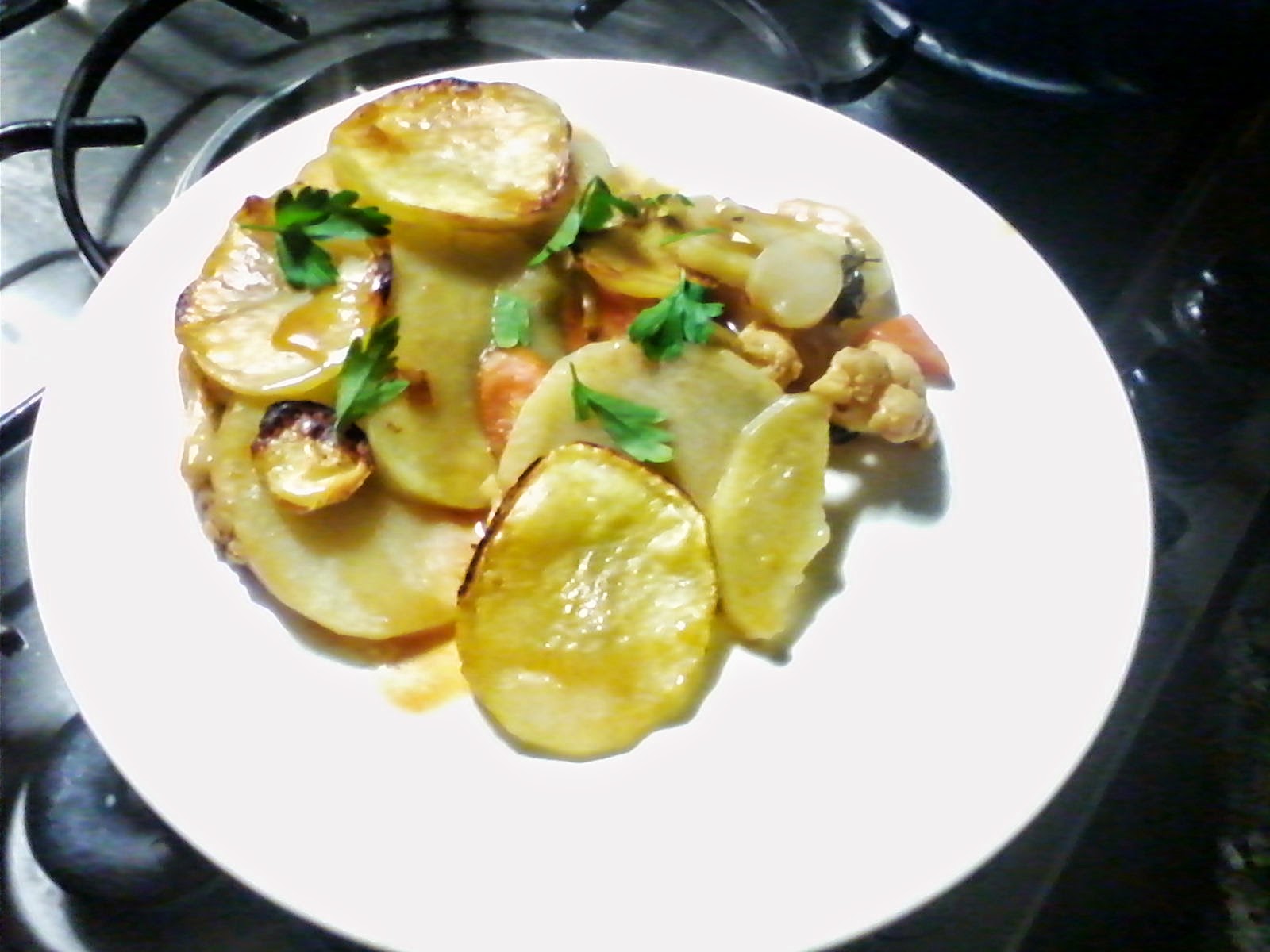
Porc à la Normandie - Cerdo Normandía

I haven’t had much by way of meat lately but a pork chop loitering in my freezer grabbed my attention.

And whilst it was defrosting my subconscious was working overtime to come up with a recipe to do justice to my sage plant and a bottle of French cider acquired recently during a reconnoitre to Granada.

I used to live in France so I know this is my made up version but at least the cider is from Normandy. The pork is Andalucian and the shallots are from France. The sage is from my Andaluz patio.

Using a suitable casserole dish this is cooking for one…

Brown a pork chop in a little oil
Sauté shallots, sliced carrot and a few cauliflower florets
Add a garlic clove
Add a splodge tomato purée
Add bay leaf, ground black pepper
Add peeled and sliced apple
Add a couple of slugs of cider
Then a ladle of hot stock to cover the ingredients
Sprinkle with dried or fresh sage
Layer with thinly sliced potatoes and a few dots of butter

Place in a preheated oven at 190°C for 35 minutes or until the top layer of potatoes have started to brown and crisp up. 


Learn more »

Multicultural gathering

Curry. What better way to bring people together. 

In rural Spain it is not easy to pop out for what in the UK is the most common takeaway, curry. 

So a few days before setting off to India I held a curry night at Casa Adora attracting nationalities from UK, France, Belgium and Spain. Oh and Diabetic Tony from the Midlands. 

They all agreed it was picante! 

For the curry lovers here was the menu: 


Learn more »

There are more chickens than people in the world

Apparently there are around 19 billion chickens in the world and I have no idea who counts them. It goes without saying that China leads the way with 371 million, even Bermuda boasts 30,000 chicks.

So I am thinking… if there are 19 billion chickens knocking around why are there people starving in some parts of the world?

And here’s what I did with 8 chicken thighs:

First, roughly chop a large onion, 6 garlic cloves and a thumb sized piece of fresh ginger root then pulse in a blender until you have a paste (add a drop of water if necessary)

Heat oil in a pan over medium heat then throw in some cumin, fennel seeds, cinnamon and chilli flakes and stir fry until the spices release their fragrant aroma

Add the onion paste; frying until it turns golden brown but not burnt

Stir in a tablespoon of garam masala, a big sprinkle of turmeric, pinch of sugar giving it a good stir before adding a 400g tin chopped tomatoes cooking for another 10 minutes or so until the tomato juice reduces

Cut the thighs into pieces and add to the pan making sure that they are all coated with the paste then add 250ml hot chicken stock and allow to simmer until the chicken is tender and the paste is thick


Sprinkle with freshly chopped coriander, serve with rice or naan bread


Learn more »

Who mentioned sausages?

And I don’t mean Androlla, Botifarra, Botillo, Chorizo, Embutido, Fuet, Longaniza, Morcón, Sobrassada or any other variety of Spanish sausage.

I was chatting with my friend Paulina in England last week. She told me that it was raining, cold and her central heating was on and that she had a scarf around her neck, I don’t know if she was implying that she was trying to hang herself but if she was then I managed to talk her out of it.

For comfort she was cooking sausage and mash. Cannot blame her really can you? But the mention of sausages must have subliminally immersed itself into my subconscious because on Saturday I found pork sausages in the butchers in Baena. I bought 6 fat bangers.

I wonder if Paulina realised that during her frozenness she actually inspired me to cook sausage, mash, caramelised onions, with an outside temperature of over 30°C that I enjoyed with a glass of wine and a view from the roof terrace, what more could one want? 

Thanks Paulina.

And with it do you prefer onion gravy, brown sauce or something else? Well, my onions were finished off with Madeira wine. Paulicious. 


Potato ricer


Learn more »

Mauritian Goat Curry

Goat meat is not easy to source in rural Andalucía unlike Brixton or places in the Midlands, and notwithstanding the number of goat herds I have seen, it was still very surprising when I stumbled across it at Carrefour - I grabbed a leg, like you do. Cabrito, a word of Spanish origin, refers specifically to young, milk-fed goat and that's what I purchased.

According to Wiki: As of 2010 goat is the most widely consumed red meat, eaten by more than 70% of the world's population. It is a staple of Africa, Asia and South/Central America, and a delicacy in a few European cuisines.

Despite being classified as red meat, goat is leaner and contains less cholesterol and fat than both lamb and beef, and fewer calories than beef or chicken; therefore, it requires low-heat, slow cooking to preserve tenderness and moisture.

I followed one of Gordon Ramsay's recipes, more or less anyway - Mauritian Goat Curry, delicious it was too.

Make a chilli paste by whizzing up a small red onion, 2 garlic cloves, 2 chillies (seeded if desired), a knob of fresh ginger, seasoning and oil ... 

Cut the meat into bite size pieces and brown in a little oil, setting aside.

Fry off the chilli paste, then add turmeric, cumin seeds, mustard seeds, cinnamon stick, a star anise (use fennel seeds if you wish) cardamom pods, brown sugar, few curry leaves, chopped fresh tomatoes, stock...

Add meat back to pan, you can add some cubed potatoes at this stage too, bring to a boil then turn down to a simmer. Open a bottle of wine then return in 3 hours or more... you may want to open another bottle - the meat should be tender and the curry will have thickened up.

Serve sprinkled with fresh coriander leaves, Indian apple pickle and naan bread on the side.


Learn more »

Willie's Wonky Chocolate Factory

Once, whilst channel hopping in a hotel in deepest Hertfordshire, I stumbled upon a re-run of Willie's Wonky Chocolate Factory. For those that don't know, Londoner William "Willie" George Harcourt-Cooze grew, imported and produced his own chocolate and Channel 4 made a fly-on-the-wall documentary about it.

I found the programme fascinating and I soon learned to love Willie and his chocolate exploits.

Now fast forward a few years and with my Tea Cargo hat on I was attending a food and drink exhibition, I cannot remember which but I am sure it was at Olympia in London. Anyway, coming towards the end of the show I ambled along an isle making way towards the exit when I heard a voice ask if I liked chocolate. When I looked over my shoulder it was coming from Willie's chocolate stand and there was Willie and he was talking to me.

I admitted that I ate chocolate once or twice a year especially Toblerone straight from the fridge. We got talking... I told him about channel hopping and discovering his TV series... one thing led to another which inevitably moved towards food. He gave me his recipe for this:

Chocolate-basted Partridge

8 oven-ready partridges
75g goose fat
4 tbsp cacao, finely grated
4 shallots, peeled and sliced
Olive oil
24 slices pancetta
Thyme sprigs

Preheat oven to 200ºC | 390º F | Gas 5

Place the goose fat and cacao in a small pan and heat until the goose fat has melted, stirring occasionally. Remove the pan from the heat and leave to cool.
Heat a little olive oil in a large frying pan. Add the shallots and fry until soft.

Season the partridges then add them to the pan, along with the shallots. Fry the birds until golden brown then remove from the pan. Leave to cool slightly, reserving the shallots and cooking juices for gravy.

Use a pastry brush to paint the birds with the chocolate goose fat. Wrap 3 slices of pancetta around each partridge, sprinkle over the thyme and roast for 25-30 minutes.

Leave the birds to rest before serving with gravy and roast vegetables.

He also gave me a block of 100% pure Nicaraguan Black which I still have today. I gave him my Tea Cargo business card and he promised to buy some of our organic Puerh tea. He never did. 


Learn more »

What to do with a coconut

Coconut milk has a place in my cooking heart. It comes out of a tin and lifts meals, enabling me to create Asian or Caribbean fusion with fish, meat and vegetables.

With a fresh coconut you can gather coconut water* - make coconut milk and grated coconut but you need time, patience, a lot of kitchen utensils (and it makes a lot of washing up too) so I took the easy way out. Using a cork screw I drained the coconut water for my electrolyte fix then several smashes later with the back of my cleaver the coconut gave up and split into two pieces.

By placing the two halves into a hot oven for 15 or 20 minutes means it is much, much easier to prise the white juicy flesh from the shell.

And like olive oil; coconut oil is a healthy option and cooks at high temperatures and it doesn't go rancid very quickly. It is good for your hair and skin too even though it is expensive to buy.

* One cup of coconut water contains more electrolytes than most sports drinks and more potassium than a banana. Now you know!

And all of this leads me to:

Chicken & Coconut Curry

Toss a skinned chicken leg (or breast) in some lime juice together with ground ginger, turmeric, cumin, coriander and a couple of bashed cardamom pods.

Sauté sliced onion in a little oil until soft then add chopped red chilli (with or without the seeds). Now add the chicken and brown off. Add the flesh of a skinned and deseeded tomato.

Stir in some coconut milk and simmer uncovered for 20 minutes or so.

Lastly stir in some garam masala and fresh coriander. Oh, and a grating of fresh coconut, if you have it.

Serve with rice or naan bread.


P.S. If you are that way out you could make hanging baskets with the shells or Zen bowls, just saying.


Learn more »

When the fridges & freezers are working overtime

It’s hot and the refrigeration equipment is working overtime to keep things cool but that doesn’t mean I want salad for supper.  I am hankering after heat, fresh and hot.

Coconut chilli chicken

Cut a chicken breast into thigh size pieces and brown in oil. Set aside and drain off most of the oil and juices.

Meanwhile, place the following into a whizzer:

Knob fresh ginger
Red chilli (fresh) with or without seeds
Clove garlic, peeled
Zest of a lime (keep the lime for later)
Bunch fresh coriander
Lemon grass
Large ripe tomato
Splash soy sauce
Splash fish sauce
White pepper

It is good to make this in advance as the ingredients get to know one and other

Place the paste into the pan you cooked the chicken in and cook over low/medium heat for a couple of minutes stirring continuously.  

Now return the chicken to the pan and add 100ml or so of coconut milk, stir, cover and leave to simmer for 20/25 minutes.

When the chicken is cooked add the lime juice and some fresh coriander leaves

And then I got carried away with Aubergine Bhaji and Coconut Naan bread.

It was fresh, hot and the sweat dripped off the end of my nose as I ate and watched the sunset go down from my roof terrace. 


Learn more »

What to do with a chicken leg

Lurking at the back of my fridge was a chicken leg. Not quite what I fancied but it needed using or freezing so I opted to jazz it up a bit by boning the leg, then stuffing it.

If you cannot get your butcher to do it then it is not so difficult to bone a leg yourself just make sure you have a sharp knife.

Stuffed chicken leg with goat’s cheese and thyme

Mix goat’s cheese with chopped fresh thyme, pepper and a little finely chopped garlic. There’s your stuffing which can be set aside.

Take a boned leg of chicken and flatten it a little then place the stuffing along the length rolling up tightly in food grade cling film sealing the end with a knot or string.

Poach the leg in a pain of boiling water for 20 minutes. Remove and allow to cool a little so that you can remove the cling film.

Heat a pan with a little oil then gently sauté the leg for a few minutes until it has taken on colour.
Serve with roasted tomatoes and shallots, garlic and thyme.

It is best served on your roof terrace around 10 pm with a glass of something of your choice. 


Learn more »

Could you watch your food being killed?

Rabitena is a 60 year old man who rears lambs in Alcaudete. His father, who was born in La Rabita, hence his name, did the same and his father's father and the one before that... so when Rabitena dispatches one of his lambs he defies diktaks from Brussels or anybody else to stop what has gone on for generations before. And who I am to complain as I chose one, watched it peacefully dispatched, skinned, gutted and cleaned. It was done with love as I swilled an obligatory bottle of Cruzcampo (chilled it was too).  

I know I am top of the food chain so I don’t have any hang-ups about what I eat but I do know that I have more of a conscience than most supermarket shoppers.

Knowing that my food is reared to the best of the ability of the farmer, has traceability and above all that no matter how young or old the animal is or was, it has been treated well and with respect and enjoyed a half decent diet, freedom and fresh air (just like we do) before being dispatched to the great farmyard in heaven where my Dad now lives.


I am not extreme about it and you’ll never find me on a protest march either but I am concerned about this and how much pollution drops out of the sky from the zillions of flights across our skies every day. I think about it but it doesn't stop me from flying.

So I eat most things including chicken’s feet but I draw the line at sheep’s eyes. 


Learn more »

A BIG and healthy curry: Don't eat it raw

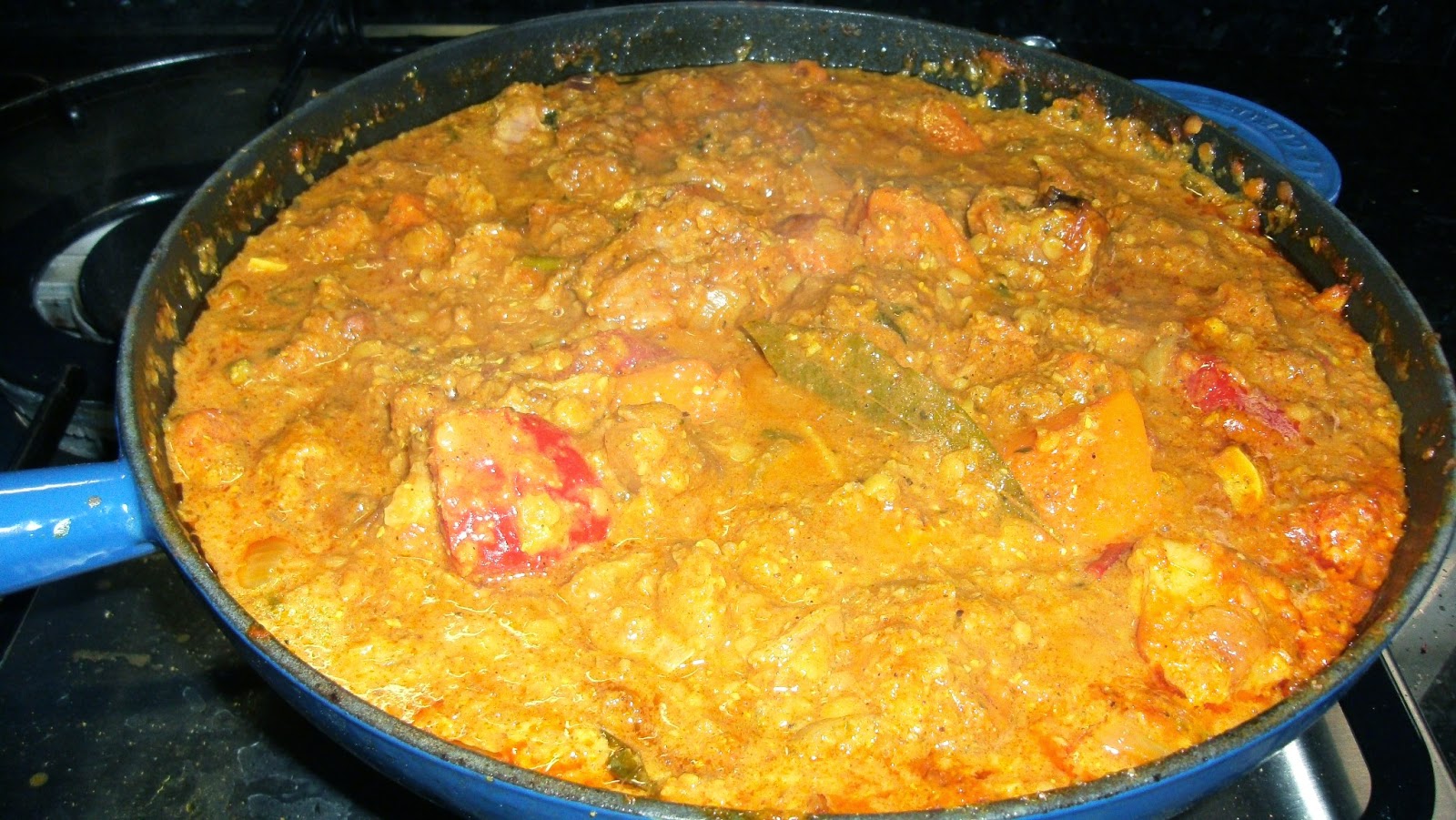
Sometimes I crave the heat and taste of curry, cooked from scratch. This recipe of cubed shoulder of lamb and butternut squash contains just about everything in my spice cupboard. The spices need to be dry fried (don’t let them burn) in order to bring out the oils and aromas.
I know that the cooking process kills off a lot of the benefits in fresh and dried herbs and spices but try eating a raw curry. My ‘healthy’ version contained:

Cinnamon/Casia bark
Cinnamon has antifungal properties, and it's been said that candida cannot live in a cinnamon environment. 

Turmeric powder
Is a potent natural anti-inflammatory that works as well as many anti-inflammatory drugs but without the side effects.

Black pepper
Black pepper stimulates the taste buds in such a way that an alert is sent to the stomach to increase hydrochloric acid secretion, thereby improving digestion.

Cumin seeds
Antioxidant content of cumin seeds has been found to be 'potent'...

Coriander seeds
In the US, coriander has recently been studied for its cholesterol-lowering effects.

Fenugreek seeds
Several human intervention trials demonstrated that the anti-diabetic effects of fenugreek seeds ameliorate most metabolic symptoms associated with type-1 and type-2 diabetes in humans.

Cardamom pods
These aromatic pods are rich in many vital vitamins, including riboflavin, niacin, vitamin-C that is essential for optimum health.

Bay leaves
Arthritis, osteoporosis and rheumatism symptoms can be eased by adding bay leaves to your diet. 

Garlic
Garlic promotes the well-being of the heart and immune systems with antioxidant properties and helps maintain healthy blood circulation. 

Ginger
Ginger improves the absorption and assimilation of essential nutrients in the body.

Parsley
A rich source of anti-oxidant nutrients.

Onions
Flavonoids promote a healthy heart; Onions are rich in flavonoids which help reduce the risk of heart disease.

Butternut squash
Butternut squash delivers an ample dose of dietary fibre, making it an exceptionally heart-friendly choice. It provides significant amounts of potassium, important for bone health, and vitamin B6, essential for the proper functioning of both the nervous and immune systems.

Cloves
The active principles in the clove are known to have antioxidant, anti-septic, local anaesthetic, anti-inflammatory, carminative and anti-flatulent properties.

Cayenne pepper
Cayenne is a well-known digestive aid. It stimulates the digestive tract, increasing the flow of enzyme production and gastric juices.

Tomatoes
Tomatoes are widely known for their outstanding antioxidant content, including, of course, their rich concentration of lycopene.

Red lentils
A fibre all-star.

Lemon
Being rich in Vitamin C, it is also essential for maintaining a fully functional immune system, aiding digestion, fighting cancer, helping wounds to heal faster and can even help to prevent heart failure.

Lamb
Grass-fed lamb is a significant source of omega-3 fats.

Now, who is for a BIG curry? I know this contains a lot of ingredients but you cannot hurry a curry - it needs time and love. 


P.S. It ALWAYS taste better the following day when things have had a chance to marry and mingle.

P.P.S. This is cooking for ONE so I shall be freezing the rest, obviously. 
Learn more »

There’s more than one type of squash

One of my sons is a squash professional but this is a different kind of squash.

Even though Francisco at Frutas Mati chopped a very large butternut squash in half for me it was still too much so after making soup and roasting some I decided to use the reminder to make a great and versatile sauce which livens up poached chicken perfectly.

This squash has a dense and deep orange flesh and it is a bit on the sweet side which makes it perfect for roasting that is easily done by drizzling olive oil over slices of squash that you have criss-crossed with the point of a sharp knife and with a grind or two of black pepper and a pinch of sea salt it will roast nicely in a hot oven enhancing its wonderful and unique flavour. 

You can make an interesting and different salad by adding the roasted squash to a salad of feta and toasted pine nuts. Mmmmm.

Butternut squash sauce

Make a mirepoix (finely chopped onion, celery and carrot) and sauté in a pan with sun flower oil over a low to medium heat. After a few minutes add chopped squash and continue to cook… adding crushed and chopped garlic, a splodge of tomato purée and ½ teaspoon of turmeric powder, stir lightly until everything is coated and has started to soften.

Add a big splash of white wine and turn the heat up a bit. When the wine has burnt off add a ladle of chicken or vegetable stock. Now cover and turn the heat down allowing things to simmer, soften and mingle.


When most of the liquid has reduced remove from the heat and allow it to cool before blending in a whizzer. Add salt and pepper to taste. 

Poached chicken with butternut squash sauce

Learn more »

What to do with coulis

Poached chicken supreme stuffed with peppers, sautéed asparagus spears and finished with red pepper coulis. 


This went very well with a chilled bottle of dry white that had been winking at me every time I opened the fridge door. 


Learn more »

Poached chicken supreme with capery spinach and celery leaves – for one

200ml chicken stock
Small glass dry white wine
½  small onion, peeled & sliced
A few  fennel seeds
One lemon
Bunch flat-leaf parsley
Extra virgin olive oil
One skinless chicken supreme  (breasts with the little wing bone attached)
Frozen spinach, enough for one
Several capers
3 cloves garlic
Lemon for zesting 
Few grates nutmeg
Seasoning

Place chicken stock, wine, onions and fennel seeds into a pan and bring up to a simmer

Zest the lemon and finely chop half of the parsley and 2 cloves of garlic mixing together in a bowl with salt and pepper, mushing things up…  set aside for a bit.

Butterfly the supreme and open like a book, spooning  in half of the parsley mixture over each.

Close the supreme and wrap tightly in cling film before placing it in the simmering stock – it should be submerged - keep simmering…  and trust me that despite being wrapped in film simmering in stock works, try it with water, it is not the same.

Chop the rest of the parsley and capers together with the remaining garlic, lemon juice and some extra virgin olive oil - taste and adjust as necessary, add this to the spinach and celery leaves - sauté for a while.

The poached chicken should be ready after 15 minutes but if it is still pink at the thick end then re-wrap and throw it back in the pan.


This is simple, fresh, moist and delicious. 
Learn more »